1946
Never Cry WolfThe year 1946 marks the convergence of ecological hardship, rabies, and a human panic that outgrew the danger it claimed to confront. In the account, a wolf that was sick and near death appeared in Churchill town amid food scarcity and an outbreak of disease. The response transformed the incident into an apparent invasion by dangerous Wolves; its aftermath shows how fear, misidentification, and repeated retelling could give that story a life of its own.
Ecological Conditions
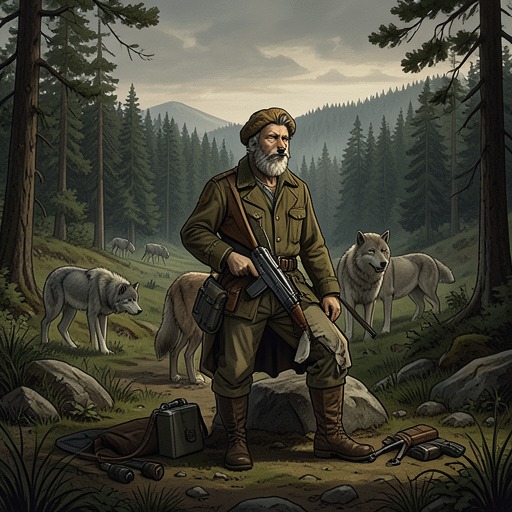
In the Canadian Arctic, Lemmings rise and fall in a four-year cycle. In 1946 they were at the low point, while the already depleted Caribou herds of Keewatin altered their longstanding migration patterns and mostly bypassed southern central Keewatin. The two changes coincided, sharply reducing available food across the region. The account describes hunger as affecting Eskimos, foxes, and Wolves alike, rather than presenting the episode as a simple consequence of wolf behavior.
The lack of food helps explain the disease outbreak. The latent rabies virus flared among starving foxes, and Wolves began contracting it as well. More broadly, the book presents epidemic disease as a constraint on wolf numbers: when food becomes scarce and animals weaken, rabies, distemper, or mange can reduce a population. That general account supplies the ecological setting for the events of 1946, although it does not make the Churchill panic itself evidence of a large, healthy wolf population.
Rabies also changes behavior in ways that people can misread. The narrator explains that affected animals do not become mad in the ordinary sense; their nervous systems make them erratic and unpredictable, and they lose their usual fear. Sick Wolves may wander into places where people live or among dog teams. Such encounters can be frightening, but the animals described are gravely ill, not representatives of an organized assault. The distinction between disease-driven behavior and a general threat from Wolves is central to the account.
The Report and the Panic
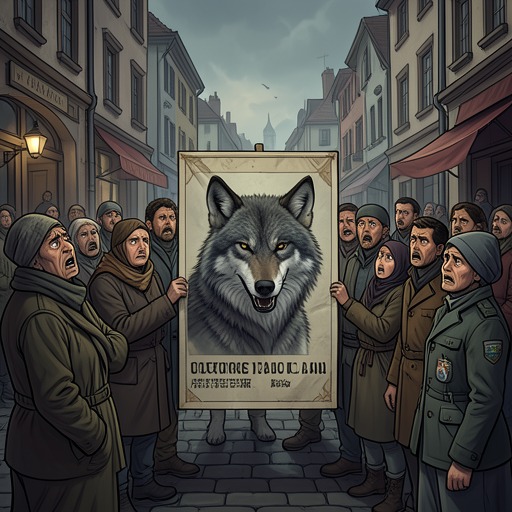
One sick wolf appeared in Churchill town during the 1946 epidemic. A Canadian Army corporal encountered it while returning to barracks after visiting the town beer hall. In his account, a gigantic wolf had leaped at him with murderous intent, and he escaped by running a mile to the guardhouse. He could offer no physical evidence of the encounter, though the narrator notes that he appeared deeply affected by it. His warning nevertheless became the immediate trigger for a military panic.
American and Canadian contingents mobilized, and armed squads searched the surrounding country with rifles, carbines, and spotlights. Within hours, the reported danger had expanded in people’s minds into several packs of starving Wolves. The scale of the response contrasted with the evidence available: a single sick animal had been reported, while the corporal could demonstrate no injury or other physical trace of an attack.
The panic disrupted ordinary life. For two days, women and children remained indoors. Foot soldiers nearly disappeared from the Army camp; those who had to travel to distant buildings went by jeep and heavily armed, or stayed away. The account presents these measures as consequences of collective alarm, not as proof that the feared invasion was taking place.
Mistaken Targets and the End of the Hunt
On the second day, a light Army aircraft joined the search and its crew glimpsed what seemed to be a wolf. A detachment of the Royal Canadian Mounted Police went out to deal with it. The animal proved to be a cocker spaniel belonging to the Hudson’s Bay Company manager. This misidentification made the gap between the force assembled and what had actually been established unmistakable: even an aerial sighting and an armed expedition had not secured the identification on which the hunt depended.
The hunt also harmed animals and people who were not the supposed enemy. During the excitement, eleven Husky dogs, an American private first class, and a Chippewayan Indian returning home late became casualties of the vigilantes, not of a wolf. The account gives no further details about their circumstances, but the distinction is emphatic: the deaths and losses associated with the panic came from the human response rather than from the animal that had prompted it.
Not until the third day did the fear begin to subside. Late that afternoon, an Army truck driver returning from the airport saw a bundle of fur on the road. He braked but could not stop in time. The wolf, by then so ill it could no longer move, was killed. This was the first confirmed end to the immediate episode, but the account does not treat it as vindication of the hunt: the animal’s helpless condition instead underscores how far the original report had traveled from the reality of a sick wolf.
The Story After 1946
The panic did not end with the wolf’s death. The narrator reports that residents of Churchill town, and soldiers elsewhere, continued to describe an invasion of Wolves in 1946. In the retellings, personal encounters became desperate struggles, women and children were said to have been attacked, dog teams were described as torn apart, and the community appeared to have lived under siege. Those claims do not match the episode as recounted. The narrator’s deliberately extravagant image of a mass of Wolves pursuing people across frozen plains exposes how legend can amplify fear well beyond the documented events.
The year therefore serves as a case study in the formation of the wolf-myth: an ecological crisis and a real disease outbreak supplied the setting, a frightening but unverified report set off the alarm, and mistaken sightings and rumor enlarged it. The wider book places such fear beside human pressures on wildlife, including trapping and government bounties for Wolves. It does not establish those policies as the cause of the 1946 rabies outbreak; rather, the comparison makes clear that public accounts of danger and actual sources of animal mortality are not the same. The lasting story of 1946 is consequently not an invasion, but the distance between a sick wolf in a hungry landscape and the threatening multitude that people later remembered.